Most hilarious exercise I have seen so far

That’s why I love Arnold’s books.

August 8, 2025 · updated August 8, 2025 · 1 min ·  misc

The double dual trick to construct a better object from the existing one

Stone–Čech compactification One of the proof of the Stone–Čech compactification is to consider the continuous functions from a given topological space $X$ to $[0, 1]$. Crux 1: constructing $[0, 1]^{C}$ Let $C$ be the space of all continuous functions from $X$ to $[0, 1]$, consider $[0, 1]^{C}$, there is a natural map from $X$ to $[0, 1]^{C}$: for each $x \in X$, define $\phi(x) = f \mapsto f(x)$. With product topology $\phi$ is continuous. Also by Tychonnof’s theorem $[0, 1]^{C}$ is compact. Now the closure of the image is obviously compact Hausdorff, and it satisfies a nice property: any continuous map $f : X \to [0, 1]$ extends uniquely to a continuous map $\overline{\phi(X)} \to [0,1]$: for any $\phi(x)$, it has to map to $f(x)$! ...

July 31, 2025 · updated August 1, 2025 · 6 min ·  mathematics

Playful observations with deformation retracts and path connected-ness

I was going through a problem in Lee’s Topological Manifolds book1 (problem 7-12). It states that the infinite broom has a strong deformation retract to $(0, 0)$ but not for $(1, 0)$ (only a deformation retract). Below is some of my playful observations inspired by this problem. (Not restricted to the infinite broom space.) Inifinite Broom Note that the deformation retract to $(0, 0)$ itselfs imply the deformation retract to $(1, 0)$, since one can define the deformation retract to $(1, 0)$ by “first retract to $(0, 0)$, then push it to the point $(1, 0)$ along the line joining these two points”. ...

July 21, 2025 · updated July 26, 2025 · 7 min ·  mathematics

Amazed by how ring theory can be linked up to topology

I am reviewing some fundamental algebra, and I just learnt something beautifully suggesting the connection of ring theory and geometry, which made me eager to learn some algebraic geometry (which I was not very interested when I was in undergrad). It is an exercise in Aluffi’s book1. Lets’ jump into it. The problem Let $K$ be a compact topological space, and let $R$ be the ring of continuous real-valued functions on $K$, with addition and multiplication defined pointwise. (i) For $p \in K$, let $M_p = \{f \in R | f(p) = 0\}$. Prove that $M_p$ is a maximal ideal in $R$. (ii) Prove that if $f_1, \dots , f_r \in R$ have no common zeros, then $(f1, \dots , fr)$ = $(1)$. (Hint: Consider $f^2_1 + \dots + f^2_r$ .) (iii) Prove that every maximal ideal $M$ in $R$ is of the form $M_p$ for some $p \in K$. (Hint: You will use the compactness of $K$ and (ii).) ...

June 26, 2025 · updated June 29, 2025 · 7 min ·  mathematics

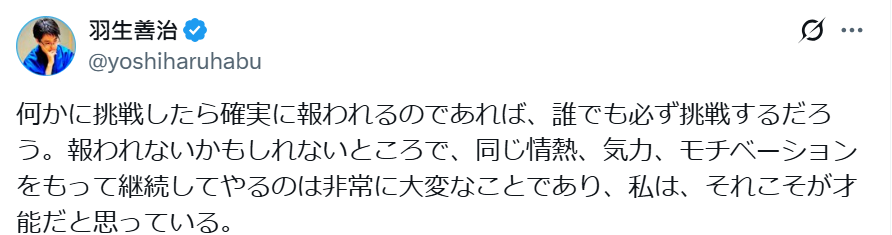
The true talent is the ability to carry on

Long time ago I read a quote from Habu1(as shown in the screenshot): The true talent is the ability to carry on with passion, even when it probably won’t pay off. (not translated word by word) I was a teenager and it did not make any sense to me. How could passion be the true talent? Look at those geniuses like Gauss, Mozart, John von Neumann! What they have done is not something that could have been done by normal people. True talent is what they have that made them do the amazing things, I thought. ...

May 13, 2025 · updated May 21, 2025 · 5 min ·  thoughts

A more intuitive explanation of Burnside's lemma

Warning ...

April 10, 2025 · updated April 10, 2025 · 5 min ·  mathematics

An elementary solution of a weird intergal problem (Putnam 1985 A5)

Problem Let $I_{m} = \int^{2\pi}_{0} \cos(x)\cos(2x)\dots\cos(mx) dx$. For $m$ in $1, 2, \dots, 10$, for which $m$ is $I_m \neq 0$ ? Solution $I_m$ is non-zero if and only if $m \equiv 0, 3 \pmod{4}$. Main idea The official(seemingly? It is in the putnam problem book and a few solutions I found online do the same.) solution is to substitute $\cos x = \frac{e^{ix} + e^{-ix}}{2}$ followed by grouping the terms into $\cos x \cos (2x) \dots \cos (mx) = e^{\text{something}}$, and analyze the something. This approach of cause is of cause good in its own right: it is exactly how you split up the $e^{in\theta}$ terms into triginometric polynomials (or ) in Fourier analysis 101. However it is a little bit annoying to manipulate those powers of $e$. And for this problem it could be done much in a much simpler and elementary way: exploiting the point of symmetry. ...

April 5, 2025 · updated April 6, 2025 · 3 min ·  mathematics

[Updated 20250408]RISC-V explainer

Info ...

March 31, 2025 · updated April 8, 2025 · 1 min ·  misc

[Updated 20250331]Centrality: how we actually perceive the severity of a bug

Info ...

February 23, 2025 · updated March 31, 2025 · 7 min ·  security

Picking grammatical mistakes in an insightful article

After the huge attention gained by deepseek R1, I have seen a good amount of people immediately went to looking for censorships (which are expected to exist), laughed at it, and looked down on it. They totally missed the points and these behaviors made them look like slaves of their very own defense mechanism1. Deepseek did make some techonological breakthroughs. Indeed the censorship is a defect of such a great product. However making jokes on it with its censorships is just like catching grammatical errors in an insightful article and disdain the article because of that. Yes, grammatical errors are errors, catching itself could be useful, but doing that for attacking an insightsul article is another thing. It just misses the point. ...

January 31, 2025 · updated January 31, 2025 · 2 min ·  thoughts